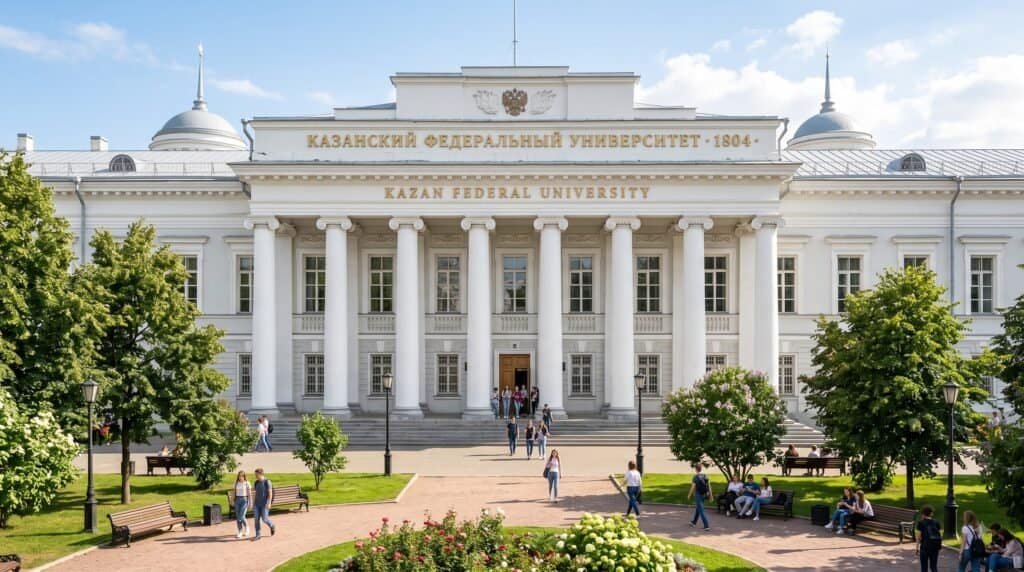
Pursuing a Bachelor of Medicine and Bachelor of Surgery (MBBS)—officially awarded as a Doctor of Medicine (MD) degree in Russia—is one of the most critical career decisions for an aspiring doctor. For Indian candidates navigating the strict guidelines set by the National Medical Commission (NMC) under the Foreign Medical Graduate Licensure Regulations (FMGLR), Kazan Federal University (KFU) stands out as a top foreign medical institution.
Located in Kazan, the vibrant capital of the Republic of Tatarstan, KFU is Russia’s second-oldest university, boasting over two centuries of scientific distinction. Known for its Institute of Fundamental Medicine and Biology (IFMB), modern medical simulation centres, 100% English-medium curriculum, and high pass rates in India’s Foreign Medical Graduate Examination (FMGE), Kazan Federal University offers an ideal balance of academic excellence and affordable medical education.
This comprehensive guide provides an in-depth review of Kazan Federal University (KFU). It covers academic accreditations, official National Board of Examinations in Medical Sciences (NBEMS) FMGE performance statistics from 2022 through 2025, the university fee structure, city connectivity from Moscow, nearby tourist attractions, safety standards, hostel facilities, and step-by-step admission guidelines.
1. Overview of Kazan Federal University (KFU) & Scientific Heritage
Founded in 1804 by Emperor Alexander I, Kazan Federal University (KFU) has been a pillar of higher education and scientific research in Eastern Europe for over 220 years. In 2010, the university achieved elite Federal University status by Presidential decree—a prestigious designation held by only ten higher education institutions across the Russian Federation.
KFU’s scientific contributions have shaped modern science and technology:
- Nikolai Lobachevsky, world-renowned mathematician and pioneer of Non-Euclidean Geometry, served as rector of KFU.
- Aleksandr Butlerov and Vladimir Markovnikov, founding fathers of structural organic chemistry, conducted their ground-breaking experiments in KFU laboratories.
- Yevgeny Zavoisky discovered Electron Spin Resonance (ESR) at KFU in 1944—a discovery that laid the fundamental physics foundation for modern Magnetic Resonance Imaging (MRI) diagnostic scanners used worldwide today.
In 2012, KFU created the Institute of Fundamental Medicine and Biology (IFMB) to integrate biomedical research directly with patient care and clinical medicine. Today, KFU educates over 50,000 students—including more than 11,000 international students from 101 countries—making it a vibrant global education hub.
Institutional Profile at a Glance
| Parameter | Official University Specification |
| Official Name | Kazan (Volga Region) Federal University – Institute of Fundamental Medicine and Biology (IFMB) |
| Year Established | 1804 (222+ Years of Academic Heritage) |
| University Category | Russian Federal Government Research University |
| Global Ranking | Ranked among Top 350 universities globally; awarded 5+ Stars by QS Stars Audit |
| Degree Awarded | Doctor of Medicine (MD / MBBS Equivalent) |
| Medium of Instruction | 100% English Medium for theoretical and clinical courses |
| Duration of Study | 6 Years (5 Years 8 Months Coursework + Compulsory Clinical Internship) |
| NMC Compliance | Fully compliant with National Medical Commission FMGLR guidelines (54 months + 12 months internship) |
2. Institutional Accreditations, World Rankings & NMC Compliance
Degree validation and global practice rights are primary concerns for candidates considering foreign medical programs. Kazan Federal University satisfies all statutory requirements set by international and Indian medical authorities:
1. National Medical Commission (NMC / former MCI) Compliance
The National Medical Commission (NMC) of India established strict regulations under the Foreign Medical Graduate Licensure Regulations (FMGLR). Kazan Federal University complies fully with every requirement:
- Course Duration: The General Medicine (MD) program spans 6 years, comprising 54 months of intensive academic study and clinical rotations followed by a compulsory 12-month rotating internship at university-affiliated hospitals.
- English Medium Instruction: All lectures, laboratory practicals, hospital ward rounds, clinical assessments, and final state licensing examinations are conducted in English.
- NMC Syllabus Alignment: The curriculum covers every pre-clinical, para-clinical, and clinical subject mandated by the NMC, including Human Anatomy, Physiology, Biochemistry, Pathology, Pharmacology, Microbiology, Forensic Medicine, General Surgery, Internal Medicine, Obstetrics & Gynaecology, Pediatrics, Orthopedics, and Ophthalmology.
- Local Licensure Rights: KFU medical graduates are fully eligible to sit for the Russian State Licensing Examination. Upon passing, they receive a license to practice medicine in Russia, satisfying the NMC rule that foreign graduates must hold valid local practice rights prior to seeking registration in India.
2. Global Accreditations & Recognitions
- World Health Organization (WHO): Listed in the World Directory of Medical Schools (WDOMS), ensuring global recognition of KFU degrees.
- ECFMG & FAIMER (United States): Accredited by the Educational Commission for Foreign Medical Graduates, making KFU students eligible for USMLE Step 1 and Step 2 licensing exams for medical residency in the USA.
- General Medical Council (GMC – United Kingdom): Recognized by the GMC, allowing KFU graduates to apply for the PLAB exam pathway for medical licensure in the UK.
- WFME Standard Recognition: Accredited under World Federation for Medical Education global guidelines.
3. Official FMGE Performance Analysis (NBEMS Government Reports 2022–2025)
The ultimate benchmark for evaluating any foreign medical university is its graduates’ performance in the Foreign Medical Graduate Examination (FMGE), conducted biannually by India’s National Board of Examinations in Medical Sciences (NBEMS).
According to official NBEMS statistical bulletins published on the official government portal (natboard.edu.in), Kazan Federal University consistently posts high passing percentages among Russian medical universities.
Official NBEMS FMGE Result Data: Kazan Federal University (KFU)
| Examination Year / Session | Total Candidates Appeared | Qualified Candidates | KFU Pass Rate (%) | Global FMGE Pass Rate Average | Official Government Portal Link |
| FMGE 2022 | 11 | 5 | 45.45% | ~19.20% | NBEMS Official Portal |
| FMGE 2023 | 15 | 8 | 53.33% | ~20.57% | NBEMS Official Portal |
| FMGE 2024 | 19 | 13 | 68.42% | ~25.80% | NBEMS Official Portal |
| FMGE 2025 | 24 | 21 | 87.50% | ~23.94% | NBEMS Official Portal |
FMGE Pass Percentage Trajectory - Kazan Federal University (2022 - 2025)
-------------------------------------------------------------------------
2022 : [█████████████████████                     ] 45.45%
2023 : [█████████████████████████                 ] 53.33%
2024 : [████████████████████████████████          ] 68.42%
2025 : [███████████████████████████████████████   ] 87.50%
-------------------------------------------------------------------------
Key Analytical Takeaways from FMGE Data
- Steady Growth: KFU’s FMGE pass rate grew significantly from 45.45% in 2022 to 87.50% in December 2025, demonstrating the university’s continuous focus on academic quality.
- Outperforming National Benchmarks: While overall global FMGE pass rates typically hover around 18% to 25%, KFU graduates consistently exceed national averages due to early clinical integration and structured exam preparation.
For raw statistical booklets and official government reports, visit the web portal of the National Board of Examinations in Medical Sciences (NBEMS).
4. Academic Structure, Medical Simulation Centre & Clinical Exposure
Medical education at Kazan Federal University combines fundamental biomedical research with extensive, hands-on clinical practicals.
State-of-the-Art Medical Simulation Centre
A highlight of KFU’s Institute of Fundamental Medicine and Biology is its multi-story Medical Simulation Centre. This virtual hospital training complex allows students to master clinical skills before working with real hospital patients.
+-----------------------------------------------------------------------+
|               KFU MEDICAL SIMULATION CENTRE HIGHLIGHTS                |
+-----------------------------------------------------------------------+
|  1. Virtual Hospital Ward (High-Fidelity Humanoid Manikins)           |
|  2. Intensive Care & Emergency Trauma Unit (ICU Simulators)           |
|  3. Surgical Skills Suite (Laparoscopic & Haptic Feedback Trainers)   |
|  4. Obstetrics & Gynecological Birth Simulation Suite                 |
|  5. Dental Phantom Simulation Laboratories                            |
|  6. 3D Anatomage Virtual Dissection Tables                            |
+-----------------------------------------------------------------------+
Advanced Training Technologies Include:
- Robotic Humanoid Manikins: Simulators that mimic human physiological responses, including pupillary light reflexes, cardiac arrhythmias, abnormal breath sounds, and dynamic responses to administered pharmaceuticals.
- Laparoscopic & Surgical Simulators: Haptic-feedback systems that allow medical students to practice minimally invasive surgical procedures, suturing, and endoscopy.
- Virtual Anatomage Dissection Tables: Interactive 3D visualization systems that allow students to explore full-body digital human anatomy, cross-sections, and complex pathological cases.
- Dental Phantom Suites: Dedicated clinical simulation stations for dentistry and maxillofacial surgical training.
Clinical Rotations at University Clinics
Starting in their 4th academic year, students transition from lecture halls and simulation suites directly to hospital wards. KFU operates its own University Clinic (Uniklinika) alongside major regional teaching hospitals across Kazan:
- KFU University Hospital: A multi-specialty clinical facility equipped with 3T MRI, 128-slice CT scanners, PET-CT diagnostic suites, and modern operating theaters.
- Republic Clinical Hospital of Tatarstan: One of the largest tertiary referral centers in Russia, exposing students to complex surgical, neurological, cardiological, and organ transplant cases.
- Kazan City Clinical Hospital No. 7: A high-volume emergency and trauma hospital where students gain fast-paced acute care experience.
- Children’s Republic Clinical Hospital: Provides specialized practical rotations in pediatrics, pediatric surgery, and neonatology.
5. Year-by-Year Syllabus Overview (6-Year MD Program)
The 6-year General Medicine curriculum at KFU follows a structured progression across preclinical, paraclinical, and clinical phases:
Year 1 & 2: Pre-Clinical Sciences & Language Integration
-----------------------------------------------------------------------------
* Human Anatomy & Histology           * Medical Biochemistry & Biophysics
* Medical Biology & Medical Genetics  * Russian Language (Conversational Practice)
* Human Physiology & Cytology         * Bioethics & History of Medicine

Year 3: Para-Clinical Medical Foundations
-----------------------------------------------------------------------------
* General Pathology & Pathophysiology * Medical Microbiology & Virology
* Pharmacology & Therapeutics         * Propedeutics of Internal Diseases
* General Surgery & Anesthesiology    * Epidemiology & Clinical Hygiene

Years 4 to 6: Advanced Clinical Rotations & Clerkships
-----------------------------------------------------------------------------
* Internal Medicine & Cardiology      * General Surgery & Orthopedics
* Obstetrics & Gynecology             * Pediatrics & Neonatology
* Neurology & Psychiatry              * Ophthalmology & Otorhinolaryngology (ENT)
* Dermatology & Venereology           * Oncology & Diagnostic Radiology
* Emergency & Intensive Care Medicine * Forensic Medicine & Clinical Toxicology
6. Fee Structure Overview
Below is the fee breakdown for the 31.05.01 General Medicine (MBBS / MD) English-medium program at Kazan Federal University. Official financial details can be directly verified on the Kazan Federal University Official Website.
Annual Fee Breakdown in Russian Rubles (RUB) & Equivalent INR
| Head of Expense | Year 1 (RUB) | Years 2 to 6 (Annual RUB) | Total 6-Year Program Cost (RUB) |
| Academic Tuition Fee | 6,53,400 RUB | 6,53,400 RUB / year | 39,20,400 RUB |
| Hostel Accommodation (Universiade Village) | 70,000 RUB (Standard) | 16,000 RUB / year | 1,50,000 RUB |
| Medical Insurance & Visa Extension | 6,000 RUB | 6,000 RUB / year | 36,000 RUB |
| Medical Checkup, Biometrics & Translation | 14,000 RUB (One-time) | — | 14,000 RUB |
| Total Official Cost (RUB) | 7,43,400 RUB | 6,75,400 RUB / year | 41,20,400 RUB |
| Total Official Cost (INR – Approx.) | ~₹8,92,000 INR | ~₹8,10,000 INR / year | ~₹46,67,440 INR |
(Note: Currency estimates are based on average administrative rates including one-time registration and exchange costs. Exchange rates fluctuate over time; official tuition payments are collected in Russian Rubles directly by KFU).
Monthly Personal Living Expenses in Kazan
- Hostel Mess / Self-Cooking Food Expenses: ₹7,000 – ₹10,000 per month (~RUB 6,000 – 8,000).
- Public Transportation (Student Transit Pass): ₹1,200 – ₹1,800 per month (~RUB 1,000 – 1,500).
- Mobile SIM & High-Speed Internet: ₹500 – ₹800 per month (~RUB 400 – 600).
- Personal & Leisure Expenses: ₹3,000 – ₹5,000 per month (~RUB 3,000 – 4,000).
7. Overview of Kazan City: Distance from Moscow, Connectivity & Climate
The city of Kazan is the capital of the Republic of Tatarstan. Often described as the “Third Capital of Russia” and the “Sports Capital of Russia,” Kazan offers a welcoming, multicultural environment for international students.
                      GEOGRAPHICAL POSITION & CONNECTIVITY

                      [ MOSCOW (Capital) ]
                               |
                               |-- Flight: 1 Hour 30 Mins direct
                               |-- High-Speed Rail (M-12 / Train): 8 - 11 Hours
                               v
                      [ KAZAN CITY (Tatarstan) ]
                               |
                               +---> Volga & Kazanka River Confluence
                               +---> Population: 1.3+ Million
                               +---> High Safety Rating & Student Hub
Travel Connectivity from Moscow
- Distance: Kazan is situated approximately 800 kilometres (500 miles) east of Moscow along the Volga River.
- Travel Options:
- By Air: Frequent direct flights connect Moscow’s international airports (SVO, DME, VKO) with Kazan International Airport (KZN). Direct flight time is 1 hour and 30 minutes.
- By High-Speed & Overnight Train: Express and overnight sleeper trains depart daily from Moscow’s Kazan Railway Station (Kazansky Vokzal), arriving in central Kazan in 8 to 11 hours.
- Via M-12 Vostok Highway: The modern M-12 toll highway corridor connects Moscow directly to Kazan, reducing car and bus travel time to roughly 6.5 hours.
Climate & Living Conditions
Kazan experiences a distinct continental climate with four seasons:
- Summer (June – August): Warm and pleasant, with average temperatures between 20°C and 28°C.
- Winter (November – March): Cold and snowy, with temperatures averaging -5°C to -15°C. All university buildings, hostels, public transportation, and shopping malls feature centralized indoor heating systems.
8. Nearby Tourist Attractions & Cultural Landmarks
Kazan combines European and Asian architectural heritage. Students at KFU enjoy a rich cultural lifestyle outside of their academic schedules:
- The Kazan Kremlin (UNESCO World Heritage Site): A historic fortress complex featuring white limestone walls, administrative palaces, museums, and panoramic views of the Kazanka and Volga Rivers.
- Kul Sharif Mosque: Located inside the Kremlin complex, this architectural masterpiece is one of the largest mosques in Europe, featuring four 58-meter minarets and blue-domed roofs.
- Annunciation Cathedral: Situated directly opposite the Kul Sharif Mosque within the Kremlin walls, this historic 16th-century Orthodox cathedral reflects Kazan’s peaceful co-existence of cultures.
- Bauman Street (Kazan’s Pedestrian Arbat): A pedestrian street filled with historic architecture, outdoor cafes, performance spaces, bookstores, and student gathering spots.
- Temple of All Religions: A striking architectural monument that combines elements from major world religions into a single colourful complex.
- Kazan Family Centre (“The Cauldron”): An iconic cauldron-shaped building with a top-floor observation deck providing views across the city skyline and riverfront.
9. Safety Standards, Hostels & Student Living
Safety and living conditions are top priorities for parents and students considering overseas education. Kazan is consistently rated among the safest student cities in Russia.
Universiade Village Hostels (Derevnya Universiady)
KFU international students reside in the Universiade Village, a modern residential campus constructed for the 2013 World Summer Student Games.
+-----------------------------------------------------------------------+
|               UNIVERSIADE VILLAGE HOSTEL ACCOMMODATION                |
+-----------------------------------------------------------------------+
|  * Block-Type Apartments (2 or 3 Students per Room)                   |
|  * Private Attached Bathroom & Shower per Block                       |
|  * Fully Equipped Floor Kitchens with Electric Stoves                 |
|  * Biometric Access Gates & 24/7 Security Personnel                   |
|  * Free Campus Wi-Fi & Quiet Reading / Study Rooms                    |
|  * On-Site Laundromats, Grocery Supermarkets, & Pharmacies            |
|  * Sports Complexes, Fitness Gyms, & Outdoor Football Pitch           |
+-----------------------------------------------------------------------+
Safety & Campus Security Infrastructure
- 24/7 Gated Security: The Universiade Village complex is fully enclosed with electronic card and biometric access turnstiles. Unregistered visitors are strictly restricted.
- CCTV Surveillance: Continuous video camera monitoring covers all residential blocks, corridors, campus pathways, and public transport hubs.
- Zero Tolerance Safety Regulations: Strict campus curfew policies ensure a safe, peaceful environment for international scholars.
Indian Student Community & Food Facilities
- Indian Student Association: KFU hosts an active Indian student association that organizes traditional celebrations for Diwali, Holi, Navratri, Eid, and Indian Independence Day.
- Indian Canteens & Mess: Dedicated Indian canteens operating near the hostel grounds serve authentic South and North Indian meal options.
- Local Grocery Supermarkets: Nearby supermarkets regularly stock South Asian spices, basmati rice, lentils, and fresh produce for students who prefer self-cooking.
10. Admission Requirements & Step-by-Step Application Process
Admissions to Kazan Federal University follow a clear, merit-based entry procedure.
Academic Eligibility Criteria
- Educational Qualification: Completion of 10+2 / Higher Secondary Board Examination with Physics, Chemistry, Biology, and English.
- Minimum Marks Requirement: At least 50% aggregate marks in Physics, Chemistry, and Biology for General category applicants (minimum 40% for SC/ST/OBC categories).
- NEET Qualification: A valid, qualifying NEET-UG score as per NMC guidelines (valid for 3 years).
- Age Requirement: Applicants must be at least 17 years old on or before December 31st of the admission year.
Step-by-Step Admission Roadmap
STAGE 1: Application Submission
   |---> Submit 10th & 12th Board Marksheets, NEET Scorecard, & Passport Copy.
   |
STAGE 2: KFU Entrance Examination
   |---> Sit for KFU's Online Entrance Exam (Biology & Chemistry).
   |
STAGE 3: Official Admission Letter
   |---> Receive Provisional Admission Letter from KFU International Office.
   |
STAGE 4: Ministry Visa Invitation
   |---> KFU processes the official Student Visa Invitation through Russian Ministry.
   |
STAGE 5: Visa Stamping
   |---> Apply for Study Visa at the Russian Embassy / VFS Global center in India.
   |
STAGE 6: Arrival & University Enrollment
   |---> Airport reception in Kazan, hostel room allotment, medical checkup, & classes.
Document Checklist for Applicants
- Secondary School Certificate (Class 10th Board Certificate & Marksheet).
- Senior Secondary School Certificate (Class 12th Board Marksheet & Passing Certificate).
- Valid NEET-UG Result Scorecard.
- Passport valid for at least 18 months from the visa issuance date.
- Official Birth Certificate (translated into Russian and notarized).
- Medical Fitness Certificate including negative HIV, Hepatitis B/C, and Tuberculosis test reports.
- Passport-size photographs (3×4 cm, matte finish, white background).
11. Objective Comparison: KFU vs. Other MBBS Destinations
To help students evaluate their options objectively, the table below compares Kazan Federal University with other study avenues available to Indian medical aspirants.
Medical Education Comparison Matrix
| Parameters | Kazan Federal University (KFU) | Private Medical Colleges in India | Typical Central Asian Universities |
| Global Institutional Rank | Top 350 QS World University Ranking | Unranked globally (mostly) | Low / Unranked globally |
| Total 6-Year Tuition & Fee | ~₹35.28 Lakhs (Tuition) / ~₹46.67 Lakhs Total | ₹60 Lakhs to ₹1.2+ Crore | ₹18 Lakhs to ₹25 Lakhs |
| Capitation / Donation | Zero | High Capitation Fees in many private colleges | Zero |
| FMGE Pass Percentage | High (87.50% in Dec 2025) | N/A (Indian graduates sit for NEET-PG) | Variable (15% to 28% averages) |
| Simulation Infrastructure | Multi-story Virtual Simulation Hospital | Varies by college | Basic / Standard Laboratories |
| Hostel Accommodation | Olympic Universiade Village | Standard On-Campus Hostels | Standard Shared Apartments |
| Medium of Instruction | 100% English Medium | English | English / Bilingual |
12. Frequently Asked Questions (FAQs)
Q1: Is the MBBS degree from Kazan Federal University recognized by the NMC?
Yes. KFU’s General Medicine (MD) program complies fully with National Medical Commission Foreign Medical Graduate Licensure Regulations (FMGLR). The degree is globally recognized by WHO, ECFMG, FAIMER, and GMC.
Q2: What is the medium of instruction at KFU?
The course is taught 100% in English for theoretical lectures, practical sessions, laboratory exercises, and exams. Conversational Russian language classes are also provided to help students communicate comfortably with patients during clinical hospital rotations.
Q3: Is qualifying NEET compulsory for admission to KFU?
Yes. Under NMC guidelines and Indian law, qualifying NEET-UG is mandatory for all Indian citizens studying medicine abroad who plan to practice in India upon graduation.
Q4: Are Indian vegetarian meals available at Kazan Federal University?
Yes. Universiade Village hostels feature dedicated Indian canteens serving vegetarian and non-vegetarian South Asian meals. Hostels also feature fully equipped floor kitchens for students who prefer cooking their own food.
Q5: How safe is Kazan for female international students?
Kazan is rated among the safest cities in Russia. The university provides 24/7 security, biometric hostel access gates, continuous video surveillance, and campus security patrols, ensuring a secure environment for all students.
Final Verdict: Is KFU the Right Choice for Your Medical Career?
Kazan Federal University (KFU) represents an outstanding option for Indian medical aspirants seeking a high-quality, globally accredited medical degree abroad. With over two centuries of academic tradition, state-of-the-art simulation facilities, top-tier official FMGE performance (achieving an 87.50% pass rate in recent sessions), affordable fees, and living quarters in the Universiade Village, KFU offers a solid foundation for a successful global career in medicine.
For official university announcements, fee schedules, and direct application procedures, visit the official government web portals: National Board of Examinations in Medical Sciences (NBEMS) and Kazan Federal University Official Website.